A RETIREMENT MANIFESTO
Sell the House. Rent the World.
Why turning your home into an investment portfolio can buy you a richer, more flexible retirement.

The view most people only get for two weeks a year — for retirees who rent, it can be the whole year.
For most of our working lives we are told the same story: buy a home, pay it off, and the paid-off house is the prize at the finish line. But at retirement, that prize quietly becomes a trap. The single largest asset most people own sits idle, costs money every month, and pays nothing. There is a better way to spend your sixties and seventies — and it starts with a ‘For Sale’ sign.

The paid-off house is a non-profitable asset
A home you own outright feels like security, and emotionally it is. Financially, though, a fully owned house is dead money. Picture a paid-off home worth $600,000. That is $600,000 of your net worth earning a ‘return’ only if the local property market happens to rise — and even then, the gain is locked up where you cannot spend it without borrowing against it or selling. Meanwhile the house does not generate a single dollar of income. It is the equivalent of keeping six hundred thousand dollars in a safe in the basement and paying for the privilege.
Now reframe the same number. Invested in a diversified portfolio of stocks and bonds, $600,000 has historically produced a meaningful, spendable income. At a conservative withdrawal rate of around 6 percent, that is roughly $36,000 a year — about $3,000 every month — without touching the principal in most years. The house that paid you nothing becomes a portfolio that pays you rent money, grocery money, and plane tickets.
Add up what the house quietly takes
Owning is never free, even with no mortgage. Property taxes, homeowner’s insurance, and the slow, relentless drip of maintenance all continue for as long as you hold the keys. A reasonable rule of thumb is that a home costs 1 to 2 percent of its value every year just to keep standing — roofs, water heaters, HVAC systems, exterior paint, and the surprise repairs that always seem to arrive at the worst time. On a $600,000 home that is $6,000 to $12,000 a year leaving your pocket and never returning.
When you rent, those costs are someone else’s problem. A broken furnace is a phone call, not a five-figure invoice. There is no insurance premium tied to the structure, no property tax bill, no special assessment, no afternoon lost to chasing a contractor. For a retiree, the value of that is not only financial — it is the freedom from a long list of obligations that tie you to one spot and one set of responsibilities.
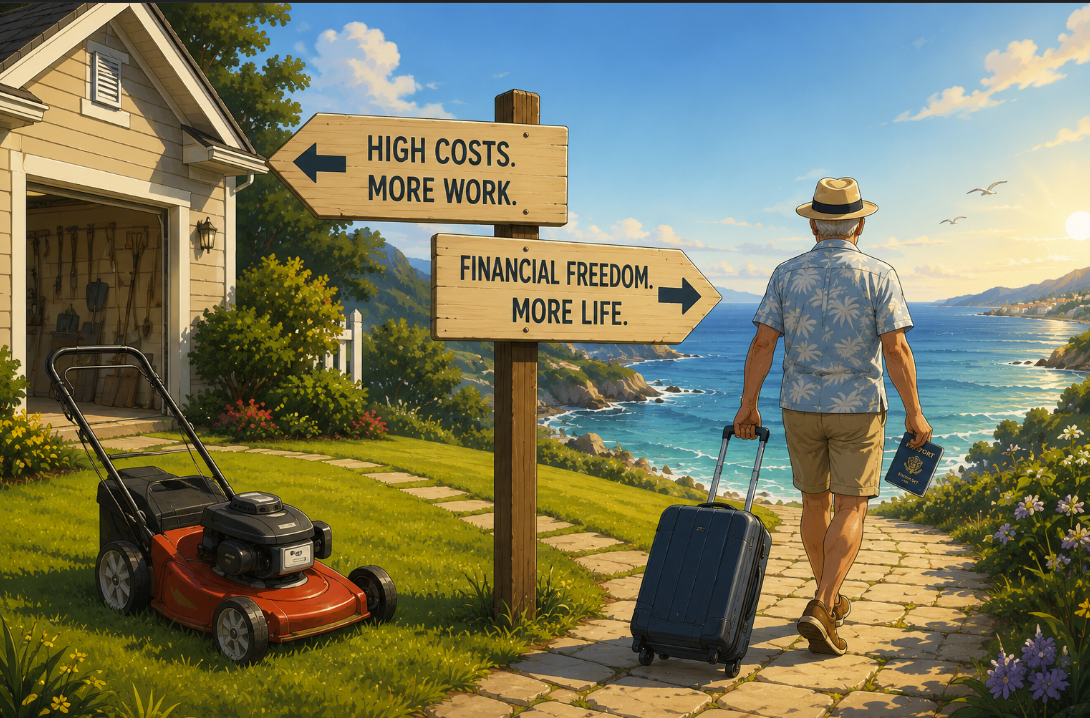
Trade the lawn mower for a boarding pass
Here is where the spreadsheet strategy translates to real life. The money that once disappeared into property taxes now sits in a portfolio generating real income — and it can fund something far more valuable than square footage: time spent living, slowly, in some of the most beautiful places on earth.
Renting untethers you from a single address. Instead of one house in one town, you can spend the cool months in southern Spain, where a comfortable apartment near the Mediterranean often costs less per month than the upkeep on a typical suburban home. When you tire of the view, you simply move. Three months in Andalusia. A long, warm winter in Thailand. A spring along the coast of Vietnam. A summer wandering the old towns of Portugal, Italy, and Greece. You are not a tourist rushing through a checklist — you are a temporary local, learning, living, and experiencing the wonders of a new place.

Months, not days, in the world’s most beautiful places
Slow travel is not just more pleasant than the two-week vacation; it is dramatically cheaper per day and far richer in experience. Monthly apartment rentals cost a fraction of nightly hotel rates. In much of Southeast Asia and parts of southern Europe, a retiree can live exceptionally well — eating out, exploring, even hiring help — on a budget that would barely cover property taxes and maintenance back home. The income from your invested house equity can comfortably cover rent in one of these places and still leave room to spare.
And the experiences themselves are the kind most people postpone until ‘someday’: morning coffee overlooking a turquoise bay, an unhurried lunch in a hill town, a sunset over limestone islands. Instead of owning a single view for thirty years, you rent a hundred different ones.
Flexibility is itself a form of wealth
Life in retirement changes, sometimes quickly. Health needs evolve, families move, and the place that suited you at 65 years old may not suit you at 80. A house anchors you to decisions made years earlier and can take months to sell when you finally need to move. Renting lets you adjust in weeks: closer to grandchildren one year, closer to a specialist hospital the next, or back to a favorite city simply because you loved it. You keep your capital liquid, your options open, and your life responsive to whatever comes.
There is also a quieter benefit. Selling the family home and investing the proceeds turns a hard-to-divide, illiquid asset into a clear, transparent portfolio — far simpler for you to manage and far simpler for your heirs to inherit.
Answering the honest objections
This path is not for everyone, and it is worth being clear-eyed. Renting means giving up the chance of further home-price appreciation and the deep comfort of a place that is unmistakably yours. Rents can rise, and markets can fall in the very years you would rather they didn’t. Some people simply love their home and the community around it, and that attachment has genuine worth that no spreadsheet captures.
But the core math is hard to dismiss. A paid-off home concentrates a huge share of your wealth into a single, illiquid, income-free asset that costs you money to hold. Selling it diversifies that wealth, turns it into income, erases the carrying costs, and hands you the freedom to live wherever life is most beautiful and most affordable. For a retiree whose priority is experience over square footage, that is a trade worth making.

The open road
You spent decades building equity. Retirement is when that equity should finally go to work for you — paying you an income, freeing you from maintenance and worry, and carrying you to the places you were always meant to see. Sell the house. Invest the proceeds. Rent the world. The finish line was never supposed to be a building. It was supposed to be a life.
This article presents one perspective for discussion and is not personalized financial advice. Investment returns are not guaranteed, and tax, healthcare, and visa rules vary by country; consult a qualified financial professional before making decisions.