Box Spread Financing, Explained: How Four Options Become a Bond
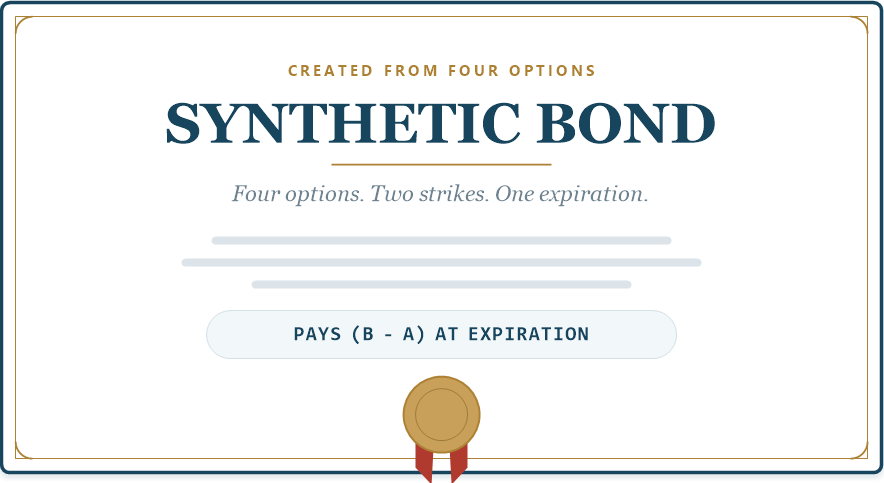
Buried in the options chain of any major index is a way to build a dollar amount fixed by contract terms, on a fixed future date — no view on the market required. It’s called a box spread. Here’s how the trade is built, what a “forward rate” actually means, and why the number it produces usually beats a Treasury bill by about 30 basis points.
Ask any advisor where to park cash you don’t want exposed to the market, and you’ll get the same answer, almost word for word: a Treasury bill. Backed by the U.S. government, cash back in weeks or months, about as close to a defined, low-risk return as money gets. That’s the conventional wisdom. It also isn’t wrong.
It’s just not the whole shelf. Sitting inside the options chain of any major stock index — the same screen most investors scroll straight past — is a second way to build that same outcome: an amount fixed by contract terms, on a fixed date, with no opinion about the market required to earn it. It’s called a box spread, and institutions, market makers, and hedge funds have quietly used it for decades. Priced correctly, it usually pays a little better than the T-Bill sitting right next to it.
You don’t need a trading desk to understand why. You need two definitions and about five minutes.
THE MECHANICS
Two Contracts, Two Strikes, Four Trades
Here are the only two definitions required. A call option is the right to buy something at a set price. A put option is the right to sell something at a set price. That’s the entire prerequisite — a box spread doesn’t take a view on which way the market moves, so understanding it doesn’t require one either.
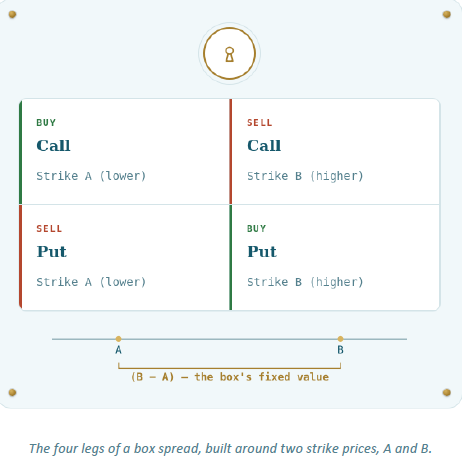
A box spread combines four of these contracts — on the same index, expiring on the same day — built around two strike prices. Call the lower one Strike A and the higher one Strike B:
→ Buy a call at Strike A
→ Sell a call at Strike B
→ Sell a put at Strike A
→ Buy a put at Strike B
Four trades, two strikes, one expiration date. Traders call it a “box” for a plain reason: quoted side by side on an exchange, the four contracts form a literal rectangle on the page — two strikes across, two option types down. The name predates spreadsheets by decades; it came from what the trade looked like on a printed sheet.
.THE PAYOFF
Why It Always Pays the Same Number
Here’s the part that looks like a trick, right up until you run the math.
Work out the payout of all four legs together, at every price the index could possibly land on when the options expire, and something happens: the index price cancels out. Completely. It doesn’t matter if the market finishes the period up twenty percent, down twenty percent, or dead flat — the box settles for exactly Strike B minus Strike A. The same dollar figure, every time.
The easiest way to see why: stop looking at four separate legs, and regroup them into two ordinary vertical spreads — the same building blocks most options traders learn in their first month. Buy Call A / Sell Call B is a bull call spread: it pays more the higher the index climbs, up to a cap. Sell Put A / Buy Put B is a bear put spread: its exact mirror image, paying more the lower the index falls, down to that same cap. Stack one on top of the other:
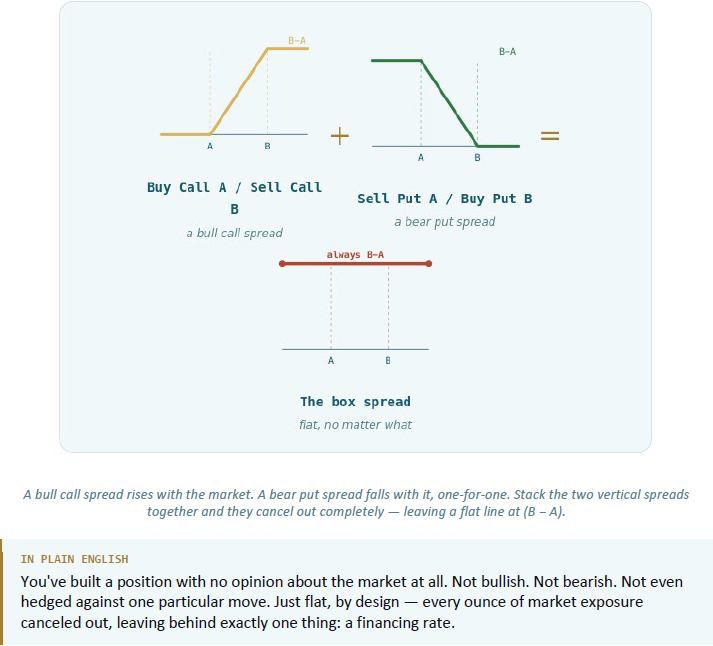
Worth saying plainly: this isn’t the same animal as selling covered calls or cash-secured puts to generate income. Those strategies keep you exposed to the market and get paid for carrying that risk. A box spread’s four legs are built to cancel each other out completely — there’s no directional bet hiding anywhere inside it. It’s a financing structure, not a trading strategy.
THE RATE
A Fixed Payout, Priced Today, Is Just a Bond
Strip out market risk and you’re left holding something a bond desk would recognize on sight: a dollar amount fixed by contract terms, due on a specific date, priced today. Pay less now, collect more later, with the amount owed set the moment the trade is placed — that’s not really an options position anymore. That’s a zero-coupon bond, wearing an options costume.
And because you know both numbers — the price today, and the payout on the date it settles — you can back out exactly one more: the rate.
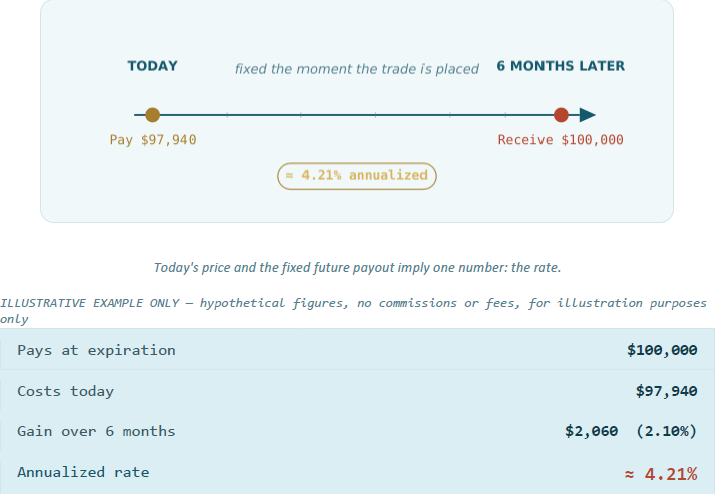
That 4.21% is the trade’s implied rate. Options desks call it the box rate, or the implied financing rate. All three names are pointing at the same idea finance people call a forward rate: an interest rate locked in today — “forward,” in advance — for money that only changes hands on one specific date down the road. Nothing to forecast. Nothing to wait on the next Fed meeting for. The rate is set the moment the trade is placed, the same way a forward contract locks in a price today for a delivery that only happens later.
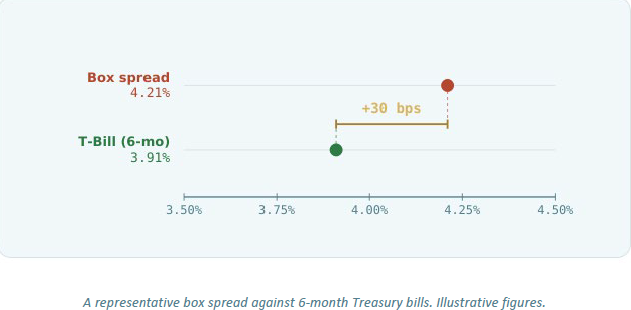
Line that 4.21% up against 6-month Treasury bills trading at roughly 3.91% around the same moment, and the box comes out about thirty basis points ahead — 0.30 percentage points, on a defined-risk, apples-to-apples basis.
That gap isn’t a typo, and it isn’t a glitch the market forgot to fix. Researchers at the Federal Reserve Bank of New York have studied it directly; Cboe, the Options Clearing Corporation’s own research, and independent analysts have all measured versions of the same thing — box rates running somewhere between roughly 0.10% and 0.50% above comparable Treasuries, most often clustering close to 0.25%–0.35%, depending on maturity and market conditions. Three forces keep that gap alive.
1. Treasuries carry a convenience premium.
A T-Bill isn’t only a return — it’s the most liquid, most universally accepted collateral on the planet, the one asset every clearinghouse, bank, and money-market fund will take at face value without a second look. Investors pay up for that convenience, the same way people pay up for the house on the corner that everyone already knows how to find. A box spread settles just as reliably, through the Options Clearing Corporation — but the OCC hasn’t spent generations becoming the world’s spare-cash equivalent. That gap in familiarity shows up as a gap in price.
2. Someone has to carry the position, and carrying isn’t free.
Every box spread has a seller on the other side of it — usually a market maker or clearing firm — and that firm ties up its own balance sheet and margin capital holding the position open until expiration. That cost of capital gets priced into the rate, the same way a locksmith charges for more than the metal in the lock. Part of what you’re paying for is someone else’s willingness to sit on the position for six months.
3. More people want to borrow this way than want to lend this way. Box-spread financing is still a well-kept secret outside sophisticated investors and advisors, so the natural buyers — the ones willing to act as lender — stay a smaller crowd than everyone who’d rather borrow at a market rate than a bank’s posted one. Fewer lenders relative to borrowers means lenders get paid a bit more to show up. Supply and demand, not a formula.
THE OTHER SIDE
The Same Rate, From the Other Side
Flip the trade around — sell the box instead of buying it — and the same mechanics run in reverse, as a loan instead of a deposit. You collect the cash today; you owe the fixed amount later. For an investor who doesn’t want to sell an appreciated position, unwind a portfolio, or walk into a bank for a securities-backed loan at whatever rate the bank feels like quoting that week, that market-implied rate on the other side of the same box is frequently well below what a loan officer will offer — while the portfolio backing it stays fully invested the entire time.
“Banks lend at their rate. The options market lends at the market’s rate.”
Same box. Same rate. One side of it lends money close to the T-Bill; the other side borrows close to the T-Bill too — usually for a good deal less than a bank would ever charge for the same certainty.
THE FINE PRINT
What the Box Isn’t
None of this makes a box spread a T-Bill with better marketing. A short list worth knowing before “defined” and “options” start feeling too comfortable sitting next to each other:
— It’s defined-risk, not risk-free. The payout is fixed by contract terms, but the counterparty is the Options Clearing Corporation, not the U.S. Treasury directly. The OCC is about as solid as a clearinghouse gets — it just isn’t the same signature on the check.
— It needs the right account. Portfolio margin, options approval, and — almost always — European-style, cash-settled contracts on a broad index, the kind that can’t be exercised early and disrupt the structure mid-trade.
— Exiting early costs something. Close a box before expiration and the price reflects that day’s market, not the rate locked in at the start. Traders have an old, unflattering nickname for the strategy for exactly this reason — the “alligator spread” — because enough separate legs, traded carelessly, can eat the return in commissions before it ever reaches you.
— It isn’t personalized advice. Whether box-spread financing has a place in your plan — tax picture included — is a conversation for your advisor and your tax professional, not a blog post.
Read the chain. Build the box. Collect the rate.
Curious whether box-spread financing has a place in your plan? That’s a twenty-minute conversation, not a sales pitch.
Further Reading
Cboe – SPX Box Spreads: Borrow or Lend With Competitive Rates
–>go.cboe.com
Options Industry Council – Box Spread Strategies for Borrowing or Lending Cash
–>optionseducation.org
Charles Schwab – What Are Box Spreads?
–>schwab.com
This material is for informational purposes only and is not an offer to buy or sell securities, nor personalized investment advice. Investing involves risk, including possible loss of principal. Options involve risk and are not suitable for all investors. Past performance is not indicative of future results. Defined-outcome structures have terms, costs, and conditions that determine results. IPS Strategic Capital is a registered investment adviser; registration does not imply a certain level of skill or training.
IPS Strategic Capital · Lakewood, CO · investps.com