By Dominick Paoloni, CIMA® | Founder & Chief Investment Officer, IPS Strategic Capital | September 29,
2026
Every time a company announces a big buyback, somebody on television calls it financial
engineering: a sugar high for the stock price that does nothing for the business. Sometimes that
critic is right. Most of the time, over long periods, the data says otherwise, and the difference
between the two comes down to one variable almost nobody talks about.
On Monday, Nvidia’s board authorized another $150 billion, the largest buyback increase any
company has ever announced. It tops the $110 billion Apple approved in 2024 and lifts Nvidia’s
remaining authorization to $235 billion, which the company expects to use through fiscal 2028.
The stock rose about 2% on the news.
My view is that this is good news for long-term shareholders. But not for the reason the
headlines give. The buyback itself creates nothing. The price paid for the shares is where the
value is made or destroyed, and on that score Nvidia is doing something unusual.
It’s not magic, it’s math: the pizza
Picture a pizza cut into 100 slices, owned by 100 people. The company takes cash it has already
earned, buys back 4 slices, and throws them away. The pizza is exactly the same size. But each of
the remaining 96 slices is now about 4% bigger. That is all a buyback is. No new pizza gets
baked.
Now the real numbers. Nvidia’s $235 billion of remaining authorization is roughly 4% of a
company valued at about $5.4 trillion. If Nvidia spends all of it at today’s prices and earns not
one dollar more, each remaining share’s claim on those earnings rises by about 4.5%. CNBC
estimates the share count could fall by about 4% if the full amount is used. Two honest caveats:
an authorization is permission, not an obligation, and new shares issued to employees will offset
part of the reduction.
So the question is never “Is a buyback good?” The question is “Did they buy the slices for less
than they’re worth?”
What 40 years of research says
The landmark study is Ikenberry, Lakonishok and Vermaelen, published in the Journal of
Financial Economics in 1995. They tracked every open-market buyback announced from 1980
to 1990 and followed the stocks for four years. On average, the announcing companies beat
comparable stocks by 12.1% over those four years. The market, in other words, underreacted: it
treated the announcement as a one-day story when it was really a four-year story.
The detail that matters most is inside the average. Companies that looked cheap, the ones most
likely buying back stock because it was undervalued, beat their benchmarks by 45.3%. Richly
valued “glamour” companies showed no lasting edge at all. The buyback wasn’t the signal. The
price was.
Three case studies: the good, the patient, and the ugly
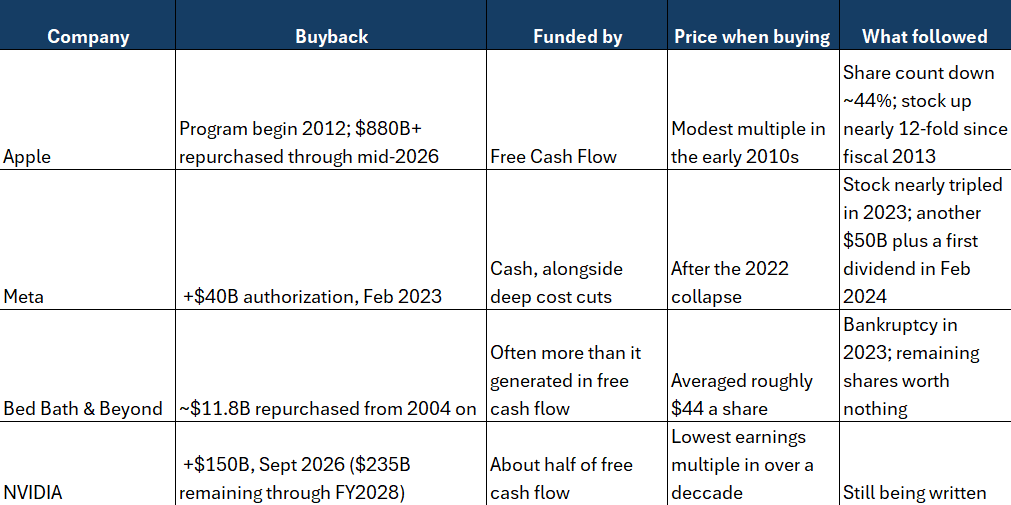
Apple, the poster child. Apple started buying back stock in 2012 and, by the middle of 2026,
had repurchased more than $880 billion of it. The share count has fallen by about 44%, which
means a share bought before the program now owns roughly 80% more of Apple’s business than
it did then. The stock is up nearly 12-fold since the start of fiscal 2013, and over the ten years
ending in early September it compounded at about 29% a year against roughly 15% for the S&P
500. Crucially, Apple paid for it out of free cash flow and never starved research, capital
spending or acquisitions to do it.
But here’s the part nobody puts in the highlight reel: in 2013, the first full year of the program,
Apple gained about 8% while the S&P 500 gained about 32%. Buybacks are a compounding
engine, not a catalyst. They reward owners measured in years, not in quarters.
Meta, buying when everyone else was selling. In February 2023, after a brutal 2022,
Meta added $40 billion to its buyback and paired it with deep cost cuts in what Mark
Zuckerberg called the “Year of Efficiency.” The company was buying its own stock at a moment
when few others wanted it. The shares nearly tripled over 2023, and a year later Meta
authorized another $50 billion and paid its first dividend.
Bed Bath & Beyond, the warning. From 2004 on, Bed Bath & Beyond spent about $11.8
billion buying back its own shares, at an average cost of more than $44 each, often spending
more than the business generated in free cash flow. It retired roughly three-quarters of its stock.
In 2023 it filed for bankruptcy and the remaining shares were worth nothing. A buyback cannot
fix a business that is losing its customers. It just speeds up the arithmetic.
Why Nvidia’s buyback passes the tests
Put those stories side by side and three tests fall out. Nvidia passes all three today.
- It’s funded by cash, not debt. Nvidia has said it plans to return about half of its free cash flow to shareholders. In its most recent quarter it returned about $26 billion, roughly $20 billion of it through buybacks. This is Apple’s model, not Bed Bath & Beyond’s.
- It’s buying at a sensible price. By Reuters’ count, the stock trades near its lowest earnings multiple in more than a decade. The shares are up about 23% this year, which sounds like a lot until you notice earnings have grown faster. CEO Jensen Huang told CNBC last month, “Buying back Nvidia stock is a tremendous opportunity.” In the language of the 1995 study, this is a glamour company buying itself at something closer to a value price.
- The business is still growing. Last month Nvidia forecast roughly 70% revenue growth for fiscal 2028, and the largest cloud companies have combined capital spending projected to exceed $1.3 trillion by 2027. This is not a company shrinking itself because it has run out of ideas. It is returning excess cash while still reinvesting.
There is also the signal. The people with the best view of Nvidia’s order book just committed $150 billion of the company’s own money at today’s price. Actions like that tend to say more than any earnings call.
What a buyback doesn’t do
Fair is fair. A buyback does not make a stock immune to a bear market. Apple fell about 26% in 2022, in a year it spent nearly $90 billion on its own shares. Nvidia is announcing this against a backdrop of intensifying competition in AI chips, and a $235 billion authorization is permission to buy, not a promise to. Most importantly, a buyback raises the value of each share you own. It does nothing to reduce how concentrated you are in one.
Own the company. Define the floor.
Many of the investors I meet sit on large Nvidia positions with enormous embedded gains. For them, this news is a reason to keep owning the company. It is not a reason to own it unprotected. Even great companies get cut in half in bear markets, and the buyback will not write your checks while you wait for the recovery.
That is why we build defined-outcome structures from two raw materials, Treasury collateral and exchange-listed options, directly in a client’s account. The goal is to keep most of the upside.
that a buyback like this is designed to compound, while limiting the downside according to the structure’s terms. You keep the company. We reshape the risk.
Before you celebrate the buyback, decide what you would do if the stock were cut in half next year. Then build that answer before you need it.
If you would like to see what that looks like for your own position, book 30 minutes with our team at calendly.com/investps/30min.
This material is for informational purposes only and is not an offer to buy or sell securities, nor personalized investment advice. Investing involves risk, including possible loss of principal. Options involve risk and are not suitable for all investors. Past performance is not indicative of future results. Share repurchase authorizations do not obligate a company to buy any shares. Defined-outcome structures have terms, costs, and conditions that determine results. [HOLDINGS DISCLOSURE — CCO TO INSERT.] IPS Strategic Capital is a registered investment adviser; registration does not imply a certain level of skill or training.
Sources (for the compliance file)
1. Reuters via Investing.com — Nvidia boosts share buyback by record $150 billion (Sept 28, 2026) — https://www.investing.com/news/stock-market-news/nvidia-adds-150-billion-to-existing-share-repurchase- plan-4919956
2. CNBC — Nvidia’s record buyback shows chipmaker’s stock is too cheap for CEO Huang to resist (Sept 29, 2026) — https://www.cnbc.com/2026/09/29/nvidia-buyback-shows-chipmaker-stock-is-too-cheap-for-huang-to-resist.html
3. TradingKey — Nvidia Q2 FY2027 capital return figures — https://www.tradingkey.com/analysis/stocks/us-stocks/262190888-nvidia-nvda-amd-jay-jason-huang-tradingkey
4. Yahoo Finance — record buyback amid rising AI-chip competition (Sept 29, 2026) — https://www.yahoo.com/news/videos/nvidia-announces-record-150-billion-083000308.html
5. Ikenberry, Lakonishok & Vermaelen, Market Underreaction to Open Market Share Repurchases, J. Financial Economics 39 (1995) — https://papers.ssrn.com/sol3/papers.cfm?abstract_id=226564
6. Motley Fool — Apple bought back more than $880 billion of its own stock (Sept 13, 2026) — https://www.fool.com/investing/2026/09/13/apple-bought-back-880-billion-stock-tim-cook/
7. TotalRealReturns — AAPL vs SPY total return, through Sept 4, 2026 — https://totalrealreturns.com/n/AAPL,SPY
8. Above Avalon — Apple’s buyback funded from free cash flow — https://www.aboveavalon.com/notes/2020/4/23/apples-460-billion-stock-buyback
9. CNBC — Meta announces $40 billion stock buyback (Feb 1, 2023) — https://www.cnbc.com/2023/02/01/facebook- parent-meta-announces-40-billion-stock-buyback.html
10. Rebound Capital — The curious case of Meta (Feb 2024 $50B authorization and first dividend) — https://reboundcapital.substack.com/p/the-curious-case-of-meta
11. CNN — The $11.8 billion mistake that led to Bed Bath & Beyond’s demise (Apr 2023) — https://www.cnn.com/2023/04/25/business/bed-bath-beyond-share-repurchases/index.html
12. Yahoo Finance — Bed Bath & Beyond: how stock buybacks undermined the company — https://finance.yahoo.com/news/bed-bath-beyond-how-stock-buybacks-undermined-the-company-154202427.html
13. Hamish Corlett — Share buybacks and long-term shareholder returns (BBBY spending vs. free cash flow) — https://hamishcorlett.substack.com/p/share-buybacks