FIDUCIARY INSIGHT · FOR PLAN SPONSORS
The 401(k) Problem Nobody Is Talking About
Your plan is probably compliant, competitively priced, and quietly failing the people it was built for.
By Dominick Paoloni, CIMA® — Founder and Chief Investment Officer, IPS Strategic Capital
Every 401(k) review I have been handed in more than three decades begins in the same two places. What does the plan cost, and how did the funds do against their benchmarks. Both are fair questions. Both get answered in a quarterly deck full of green arrows. And a plan can pass both tests cleanly and still be carrying a risk that nobody in the room has ever measured.
Here is the part nobody says out loud. A 401(k) menu is not a portfolio. It is a list. The committee approves the list, the participant builds the portfolio out of it, and no one checks whether the list makes a survivable portfolio possible in the first place.
That is the problem. It has four parts.
One — eight funds, one decision
Open a plan lineup and count the US large-cap options. In the plans we review it is routinely six, seven, eight. Growth, value, blend, a contrarian one, an index one, and one or two more added years ago that nobody has questioned since.
That is not eight decisions. That is one decision, sold eight times.
Diversification in most plans is measured by fund count. It should be measured by what the funds do when it matters. In one plan we analyzed this year — twenty-four options outside the target-date series, a well-run committee, fees at market — exactly two options finished 2022 in positive territory. Two, out of twenty-four. Everything else was a passenger on the same plane.
And inside the US large-cap sleeve alone, the spread between the best and the worst fund that year was more than thirty percentage points. Same asset class. Same label on the fact sheet. A thirty-point difference in what a participant actually lost, decided entirely by which of the eight names they happened to pick on their first day.
Two — the glide path is an opinion, and it changes after the loss
Roughly seven in ten participants hold a target-date fund (EBRI/ICI data, year-end 2023). Among plans that automatically enroll, the GAO found target-date funds to be by far the most popular qualified default investment alternative — which means that is where the money goes when an employee makes no choice at all.
So it is worth knowing what that fund actually is. It is one asset manager’s opinion about how much risk a stranger your age should be carrying — and the industry does not agree with itself. In its own review of registration statements, the SEC found equity exposure at the target date ranging from roughly 25% to 65% across target-date funds generally. The GAO found one fund at about 65% equity at its target date and another at about 33%. The Department of Labor’s guidance to plan fiduciaries says it plainly: there are considerable differences among target-date funds from different providers, even among funds with the same target date.
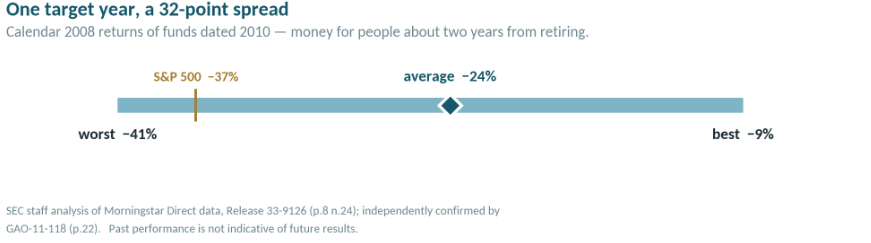
It gets more specific than that. In 2008, funds dated 2010 — money for people about two years from retiring — lost nearly 24% on average, with a range from about 9% to 41%. That is the SEC staff’s own analysis. One birthday, a thirty-two point spread in outcome.
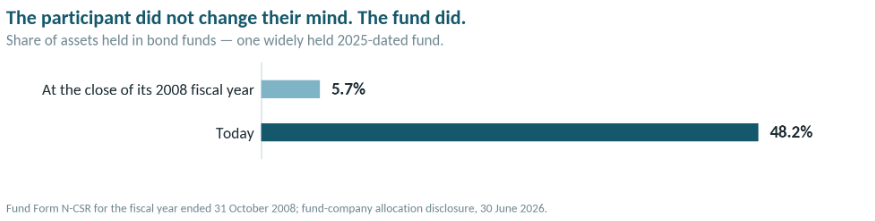
Then look at what happened next. One widely held 2025-dated fund reported 5.7% in bond funds at the close of its 2008 fiscal year. Today the same fund holds roughly 48% bonds. The participant did not change their mind about risk. The fund changed its mind — after the loss.
Three — the de-risking broke in 2022, and it broke worst at the top
The glide path makes one promise: more bonds means less risk. In 2022 the bonds were the wreckage. The US Aggregate fell 13.0%. Long Treasuries fell 31.2%. US equity fell 19.5%. Apply a dated default fund’s current asset-class weights to that year and the only sleeve that finished positive was cash — about 6% of the portfolio.
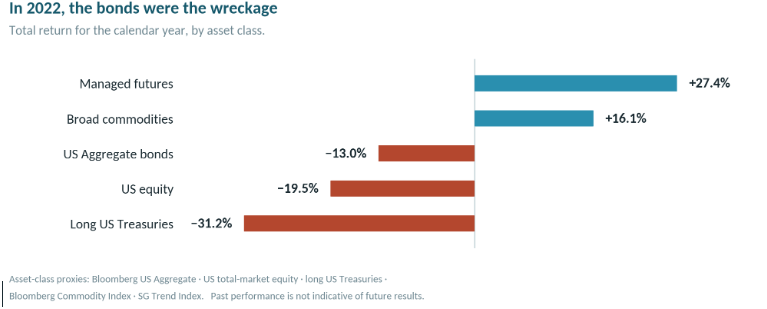
Read that again in terms of your own employees. The closer a person was to retiring, the more of their loss came from the sleeve that was supposed to protect them.
And the dollars are worst exactly where the glide path claims to be safest, because the balance is largest there. Take two of your people.

The glide path did exactly what it advertised — the older employee’s fund fell less in percentage terms — and it still cost him almost eight times the money. In plain English: sequence-of-returns risk is not removed by a glide path. It is concentrated by it, because the biggest balance sits in the allocation with the least room to recover.
Meanwhile the things that did work that year finished sharply positive at the index level — broad commodities up roughly 16%, managed futures up roughly 27%. Those are asset classes almost no plan menu lets a participant hold in meaningful size, and where a menu does offer one it is usually a single small allocation. The fire extinguisher was in a locked cabinet.
Four — the duty to monitor never ends, and it is yours
This is the part that belongs to you personally rather than to your employees.
Under Tibble v. Edison, 575 U.S. 523 (2015), a fiduciary’s duty to monitor plan investments is continuing — separate from, and in addition to, the duty to select them prudently in the first place. It does not reset when the lineup is chosen. It does not expire.
Which is why a lineup that has not been benchmarked in years is a documentation gap worth closing now, in this market, rather than after something goes wrong. A crash does not create that gap. It reveals it. We are not a law firm — your ERISA counsel is the right person to size the risk for your plan.
Most CFOs I meet have a thick binder proving the plan’s fees were reviewed. Very few have a single document showing that anyone ever tested whether the lineup could hold together in a bad year. That document is cheap to produce and uncomfortable to be without.
What the fix actually looks like
It is not more funds. Adding a ninth large-cap manager does nothing.
The fix is to build the menu so that a reasonable participant can assemble a portfolio whose pieces do not all fail at once — and to prove it against real history rather than a risk questionnaire. That means:
- Fewer, better-chosen options spanning genuinely different risk drivers — not eight versions of the same one. Low-cost index exposure at the core, with real diversifiers beside it.
- A default that is stress-tested, not just glide-pathed. If it has never been run through 2008, 2020 and 2022 as a portfolio, it has not been tested.
- A written record. Every option benchmarked on cost, behavior and redundancy, every decision documented, reviewed on a calendar rather than after a headline.
Diversify for growth. Hedge for protection. Those are two different jobs, and for more than three decades our industry has asked one tool to do both. A hedge is a contract — with a cost, a term and a payoff defined in advance. Diversification is a hope.
What IPS does, and what it costs your employees
IPS Strategic Capital is a fee-only, founder-owned registered investment adviser, founded in 1993 and headquartered in Lakewood, Colorado. We are a hedging firm before we are anything else — we build downside-management solutions for institutions, advisors and families, and we buy options as insurance rather than selling premium to manufacture income.
For a plan, we will serve as your ERISA §3(38) investment manager. The distinction is worth being precise about. A §3(21) adviser recommends, and your committee still decides and still owns the investment decision. A §3(38) manager decides and implements, and responsibility for investment selection shifts to the appointed manager, subject to your plan document and your ERISA counsel’s review. Your committee’s job narrows to prudently selecting and monitoring that manager. It does not disappear — nobody can honestly tell you it does — but it becomes far smaller and far easier to document.
Then there is the part that is unusual in a 3(38) engagement. Every employee in your plan gets the full IPS service set at no additional cost:
- Financial and retirement planning with a named advisor — at every balance level, not just the large ones
- Estate planning, including custom wills and trusts drafted with our partner attorneys, at no extra cost
- Tax-aware planning and real estate evaluation
- Concentrated-stock and equity-compensation strategy for the executives who need it
- Semiannual, plain-English seminars on site for your whole staff
These services are included in the engagement at no additional charge to the company or to participants beyond the plan’s stated investment-management fee. When you work with IPS, customer service is not a department. It is an attitude.
One question
Before you renew anything, ask whoever advises your plan today a single question:

If the answer is “stay the course,” that is a hope, not a plan — and hope is not a fiduciary process.
We will run your plan through 2008, 2020 and 2022 and put the result in writing, board-ready, at no cost and no obligation — so the committee knows its number either way.
Let IPS build a plan that doesn’t fall apart in a market crash.
Dominick Paoloni, CIMA® is the founder and Chief Investment Officer of IPS Strategic Capital in Lakewood, Colorado. He earned his CIMA® through the Wharton School, teaches finance as an adjunct professor at the University of Denver and the University of Colorado, and was recognized in Morningstar Advisor Magazine in 2009 for protecting client portfolios through the 2008 credit crisis. He is co-author of “Hedging vs. Diversification,” hosted on Cboe’s site.
215 S. Wadsworth Blvd., Suite 540, Lakewood, CO 80226 · 303.697.3174 · investps.com
This material is for informational purposes only and is not an offer to buy or sell securities, nor personalized investment advice. Investing involves risk, including possible loss of principal. Options involve risk and are not suitable for all investors. Past performance is not indicative of future results. Defined-outcome structures have terms, costs, and conditions that determine results. Plan data referenced has been anonymized. Examples are illustrative only. IPS Strategic Capital is a registered investment adviser; registration does not imply a certain level of skill or training. IPS is not a law firm or an accounting firm — consult your ERISA counsel and tax advisor regarding your plan.